
What Size Range Hood Do You Need for a 48-Inch Pro Range?
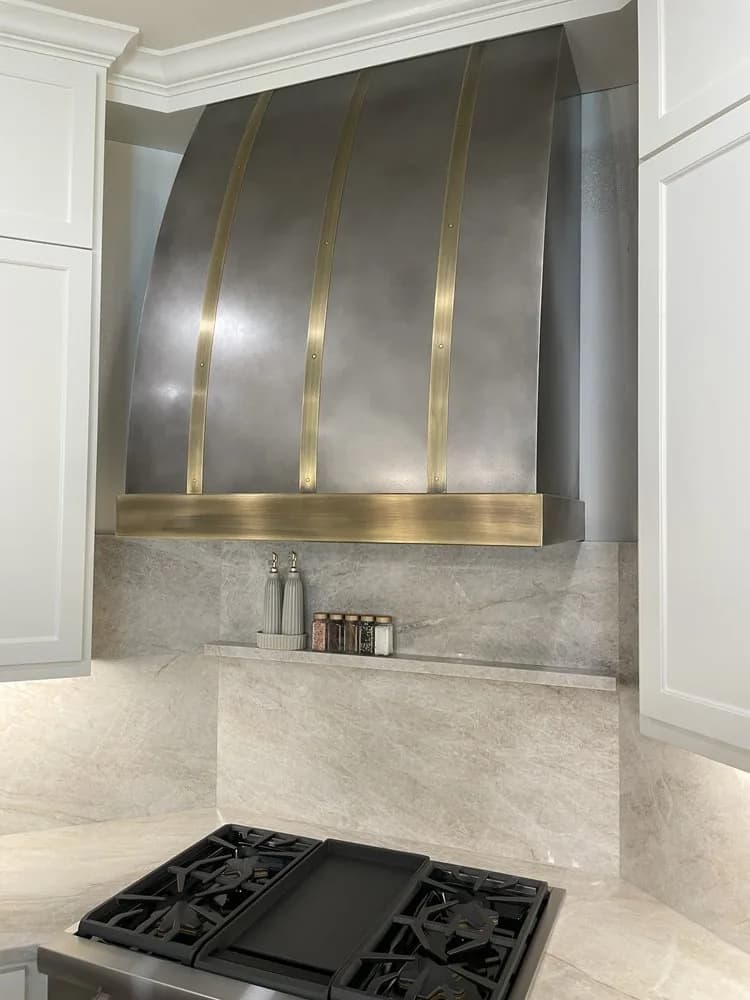
A 48-inch pro-style range is the centerpiece of a serious Texas kitchen. Six burners, a griddle or grill section, the kind of cooking surface that anchors a Highland Park or Southlake new build. The ventilation above it is the part buyers underplan, because a 48-inch range does not want a 48-inch hood and it does not want 400 CFM.
Plan on a hood 54 to 60 inches wide, moving 900 to 1,200 CFM, mounted 30 to 36 inches above the cooktop, with makeup air in the plan from day one. Here is how each of those numbers is derived, so you can check any recommendation you receive.
Width first: cover the cooking surface plus margin
Capture starts with coverage. The widely used rule is 3 to 6 inches of hood overhang beyond the cooktop on each side. For a 48-inch range, that means a 54-inch hood at minimum and a 60-inch hood for comfortable capture, especially over the outer burners where most cooking happens.
This is also why island installations want the wider end of the range. A wall hood gets help from the wall behind it, which corrals rising effluent. An island hood stands alone in moving air, so size up and consider the higher CFM guidance below. If your kitchen designer suggests a 48-inch hood over a 48-inch range to save money or visual weight, the physics disagrees. Capture area is not negotiable.
CFM by BTU math: where 900-plus comes from
For gas ranges, the accepted rule of thumb is total burner BTUs divided by 100. A 48-inch pro-style range with six burners plus a griddle or grill section commonly totals 90,000 to 110,000 BTU or more. Divide by 100 and you land at 900 to 1,100 CFM minimum. Add a grill section you actually use, and 1,200 CFM is the honest number.
The width-based method (100 CFM per foot of range width for wall hoods, 150 for islands) gives a lower number for a 48-inch range, around 400 to 600 CFM, but that method was built for standard cooking, not pro-style BTU output. For gas, the BTU math governs. When the two methods disagree, size to the BTU result and treat the width result as the floor you never go below.
Two cross-checks worth running: kitchen volume divided by four minutes of air changes (a 20 by 20 foot kitchen with 10-foot ceilings is 4,000 cubic feet, suggesting up to 1,000 CFM), and duct derating. Long duct runs cost roughly 1 CFM per foot, each elbow about 25 CFM, and the termination cap about 40 CFM. A 1,000 CFM blower behind two elbows and 20 feet of duct is really delivering something less. Short, straight, rigid ductwork is worth real performance.
Mount height: 30 to 36 inches for pro gas
Ventilation makers generally recommend 30 to 36 inches between the cooktop and the bottom of the hood for pro-style gas ranges. Closer improves capture but risks heat damage to the hood’s finish and controls; higher looks airier but lets effluent escape the capture zone, especially on the front burners. Measure from the cooking surface, not the floor, and confirm the height against your range manufacturer’s clearance specs before the hood is drawn. Ceiling height enters here too: 10- and 12-foot Texas ceilings are common, and the chimney or canopy extension must be sized for the actual ceiling, not a standard one.
The makeup air trigger you cannot skip
Here is where the 48-inch pro range conversation always lands. Anything rated over 400 CFM triggers makeup air requirements under the mechanical code, and a 900 to 1,200 CFM setup for a 48-inch range is far past that line. In Dallas, which enforces the 2021 International Residential Code, expect a dedicated makeup air system with a motorized damper interlocked to the exhaust. This is HVAC contractor work during rough-in, and it needs to be in the plan before drywall.
Do not let this shrink your ambition. The code path for high-CFM hoods is well traveled. Read the full breakdown in Do You Need Makeup Air for a Range Hood Over 400 CFM in Dallas? and bring your city’s answer to the design conversation.
What this means for the custom shell
A 54- to 60-inch handcrafted hood is a substantial piece of metalwork, and it should be drawn around the ventilation plan, not the other way around. Decide the insert and its CFM first, confirm the makeup air path, then commission the shell to the exact width, depth, and ceiling height. That order is how you avoid a beautiful hood that fights its own blower.
This is the normal sequence at Monarch. The Garland, Texas studio draws every hood to the buyer’s measurements, settles shape, size, straps, rivets, and finish on approved drawings, then handcrafts the piece and crates it for delivery anywhere in the country. A 60-inch strapped copper hood over a 48-inch range is exactly the kind of project the studio exists for, and the 5.0 rating across 34 Google reviews reflects kitchens that planned the ventilation first.
48-inch pro range ventilation questions
Can I use a 48-inch hood over a 48-inch range?
You can, but capture suffers at the outer burners. The 3-to-6-inch per side overhang rule points at 54 to 60 inches. If visual weight is the concern, a well-designed 54-inch hood looks more intentional than an undersized 48.
Is 1,200 CFM overkill for residential cooking?
Not over a 48-inch pro range with a grill or griddle. The BTU math, 90,000-plus BTU divided by 100, is what sets the number. An underpowered hood over a pro range is the most common ventilation regret in high-end kitchens.
Wall hood vs. island hood for a 48-inch range?
A wall placement captures better with less CFM because the wall helps contain rising effluent. An island 48-inch range needs the wider hood, the higher CFM, and more careful attention to mount height and cross-drafts from nearby doors and windows.
My ceilings are 12 feet. Does that change anything?
Yes. The hood body still mounts 30 to 36 inches above the cooktop, but the chimney or canopy extension must bridge the remaining distance to the ceiling. Give the studio your exact ceiling height with your measurements so the extension is fabricated correctly.
Do I really need makeup air for 900 CFM in Dallas?
Yes, plan on it. The code threshold is 400 CFM, and 900 is well past it. Your HVAC contractor installs a dampered makeup air duct interlocked with the hood during rough-in. Confirm the details with your city’s building inspection department.
Should the hood be wider than the range even with high CFM?
Yes. CFM moves air; width captures it. A narrow hood with a huge blower still misses effluent that rises outside its footprint. Width and CFM solve different halves of the problem.
Size it once, on paper, before anything is cut
The 48-inch pro range deserves ventilation planned with the same seriousness as the range itself. Run the BTU math, size the width with real overhang, confirm the makeup air path, then commission metalwork drawn to fit.
Get a quote with your range model and ceiling height. See the two ways to bring home a Monarch hood, and check lead times and process details.
Keep reading
- Do You Need Makeup Air for a Range Hood Over 400 CFM in Dallas?Dallas enforces the 400 CFM makeup air rule for range hoods. Learn when it applies, what compliance looks like, and how to plan your kitchen around it.
- Range Hood Shell vs. Insert: What Dallas Renovators Should KnowA shell is the metal exterior. An insert is the ventilation inside. How Dallas renovators pair the two, what each costs, and the order that avoids rework.