
New Jersey
Before You Order a High-Power Range Hood in New Jersey
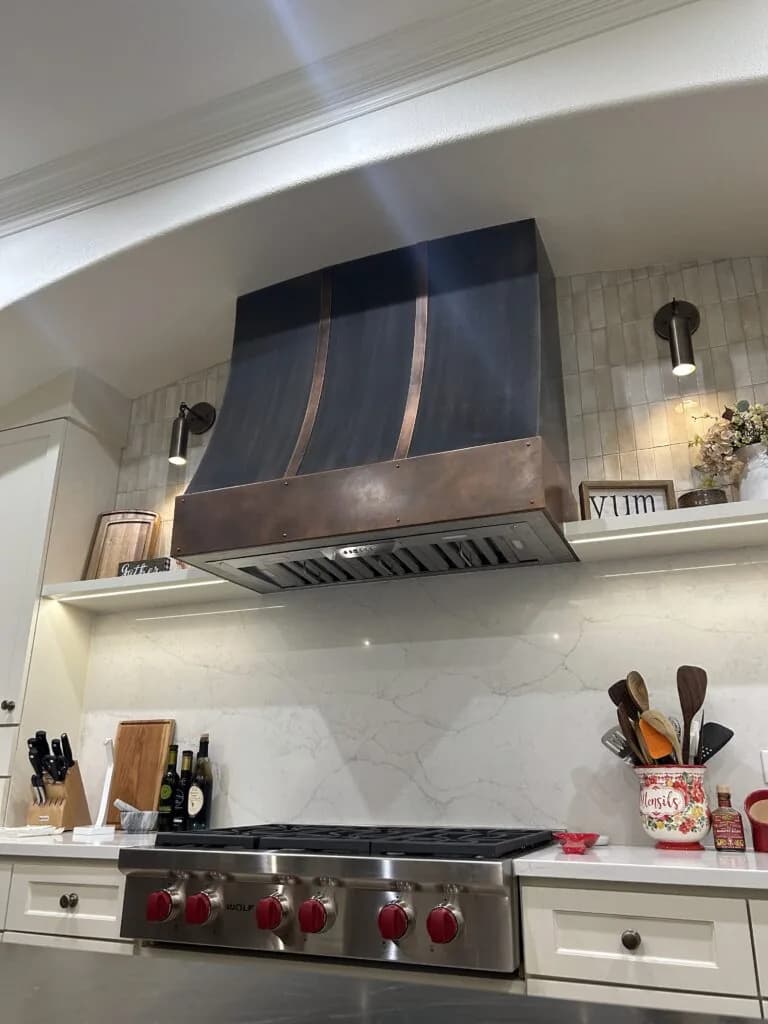
A professional-style range often prompts an immediate question: how powerful should the hood be? Airflow, measured in cubic feet per minute (CFM), is only part of the answer.
The equipment needs to suit the cooking appliance, the duct route, the hood configuration, and the house it is installed in. For a New Jersey renovation, that may mean reviewing an existing system. In a new build, it means giving the mechanical design enough attention before walls and ceilings are closed.
Monarch’s NY/NJ team coordinates custom range hood projects across New Jersey, from initial design through drawing approval and delivery planning. The decorative hood is developed around the equipment and requirements established for your project.
Start with the appliance you are actually buying
Send the exact range or cooktop model, including any griddle, grill, or other configuration that affects the manufacturer’s ventilation recommendations. Nominal width alone is not enough.
The Home Ventilating Institute specifically advises following the cooktop manufacturer’s recommendations for professional-style appliances. Treat a general airflow calculator as background information, not the final specification for a particular range.
Ask the appliance and mechanical professionals to agree on the proposed insert or liner, blower arrangement, and installation requirements. The hood drawing should reflect that selection rather than leave the working components to be chosen after the metal enclosure is complete.
Include the duct route in the decision
A larger blower does not remove a duct constraint. Before ordering, ask the contractor to identify the available route, duct dimensions, changes of direction, and exterior termination.
The Department of Energy’s kitchen exhaust retrofit guidance emphasizes using the manufacturer’s recommended duct size and a short, direct route. For a renovation, this makes an assessment of the existing duct particularly important.
If the new equipment needs a different route, understand what construction that entails. It may affect a soffit, ceiling, wall, or the shape of the hood’s upper section. Resolve those relationships with the designer before assuming the work can be concealed inside the canopy.
Ask about replacement air before selecting high airflow
Air exhausted from a house must be replaced. Makeup air is the planned supply of replacement air associated with an exhaust system.
The safety issue deserves attention when the home has fuel-burning equipment. Pacific Northwest National Laboratory’s combustion-safety guidance explains that exhaust fans can affect natural-draft appliances and contribute to combustion gases spilling into the home under unfavorable pressure conditions.
Tell the mechanical professional about the home’s furnace, boiler, water heater, and fireplaces, including any equipment being changed during the renovation. Have the need for makeup air and the overall pressure balance assessed for the whole project, not just the new cooking appliance.
Check the rules for the actual renovation
New Jersey’s current construction codes include separate provisions for residential, mechanical, and rehabilitation work. Which requirements govern depends on the building and the scope of the project, including applicable state amendments and permit conditions.
That is why a statement such as “every hood over 400 CFM needs the same solution” is not an adequate design instruction. The selected system needs to be reviewed against the applicable requirements by the project professional and local construction office where necessary.
Request a clear answer before ordering: whether replacement-air provisions are required, how they will work, where the components will be located, and who is responsible for supplying and installing them.
Make room for the equipment without losing the design
Once the mechanical arrangement is defined, the metalwork can be developed around it.
Check the insert opening, the space needed above it, access to serviceable parts, and the position of the duct connection. Review those in section as well as in a front elevation. A narrow upper profile or a low, shallow body may need adjustment to accommodate the chosen equipment.
The visible design can still be restrained. Consider a simple body with a carefully proportioned band, or a finish that relates to the cabinetry without repeating every appliance surface. With Monarch’s fully custom hoods, those choices can be developed alongside the technical dimensions.
Before approving the order, have the quotation identify the canopy, ventilation components, delivery arrangements, and installation responsibilities. Keep that scope with the approved drawings so each supplier is working toward the same result.
New Jersey ventilation questions
Is more CFM always better?
No. The appropriate airflow depends on the cooking equipment and the complete installation. Excess capacity is not a substitute for suitable coverage, ducting, or a properly coordinated air-supply arrangement.
Does a 48-inch range automatically need a particular blower?
No. Use the actual model and its ventilation guidance. Two ranges with the same nominal width can have different configurations and requirements.
Who decides whether makeup air is needed?
The qualified mechanical professional should assess the home and applicable code requirements, with the local construction office involved as needed. Resolve that before the hood specification is finalized.
Does the same team handle northern and southern New Jersey projects?
Yes. Kaitlin and Brendan are Monarch’s regional contacts for New Jersey, including northern and central communities, the Jersey Shore, and southern New Jersey.
Send the appliance and mechanical information together
Discuss your New Jersey project with the NY/NJ team. Include the range specification, kitchen elevation, and proposed ventilation equipment. Where a decision is still open, identify it clearly so the hood can be developed without relying on an assumption that changes later.
Keep reading
- Specifying a Custom Range Hood: A Guide for NY/NJ Design TeamsA guide for NY/NJ designers, builders and cabinetmakers covering hood drawings, equipment, finishes, approvals and delivery coordination.
- Choosing a Range Hood for a Long Island or Hamptons KitchenChoose a custom hood for a Long Island or Hamptons kitchen with advice on finish samples, mixed metals, proportions and coastal settings.