
A curved hood changes the feel of a kitchen more than any other shape. It softens a room of hard cabinet lines, gives the range a sense of arrival, and lets brass straps sweep instead of drop. But “curved” covers several very different forms, and each one wants a different ceiling height and a different kitchen. Here is how to tell them apart, using hoods we have built and the designs in our Long Island Collection.
The four curves
The Monarch curve. The body sweeps outward toward the bottom, like a skirt. It is the most familiar curved hood and our most requested silhouette. The Monarch Collection hood in Saddle River, New Jersey, the Huntington, the Manhasset and the Belle Terre all feature variations of the Monarch shape.
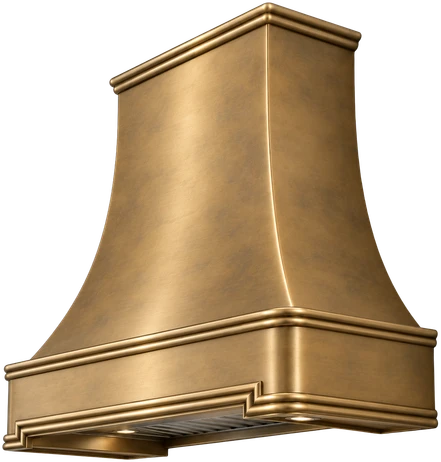
The convex curve. The body swells and then tucks in, so the profile rounds out like a bell. The Northport features a bell-shaped body.
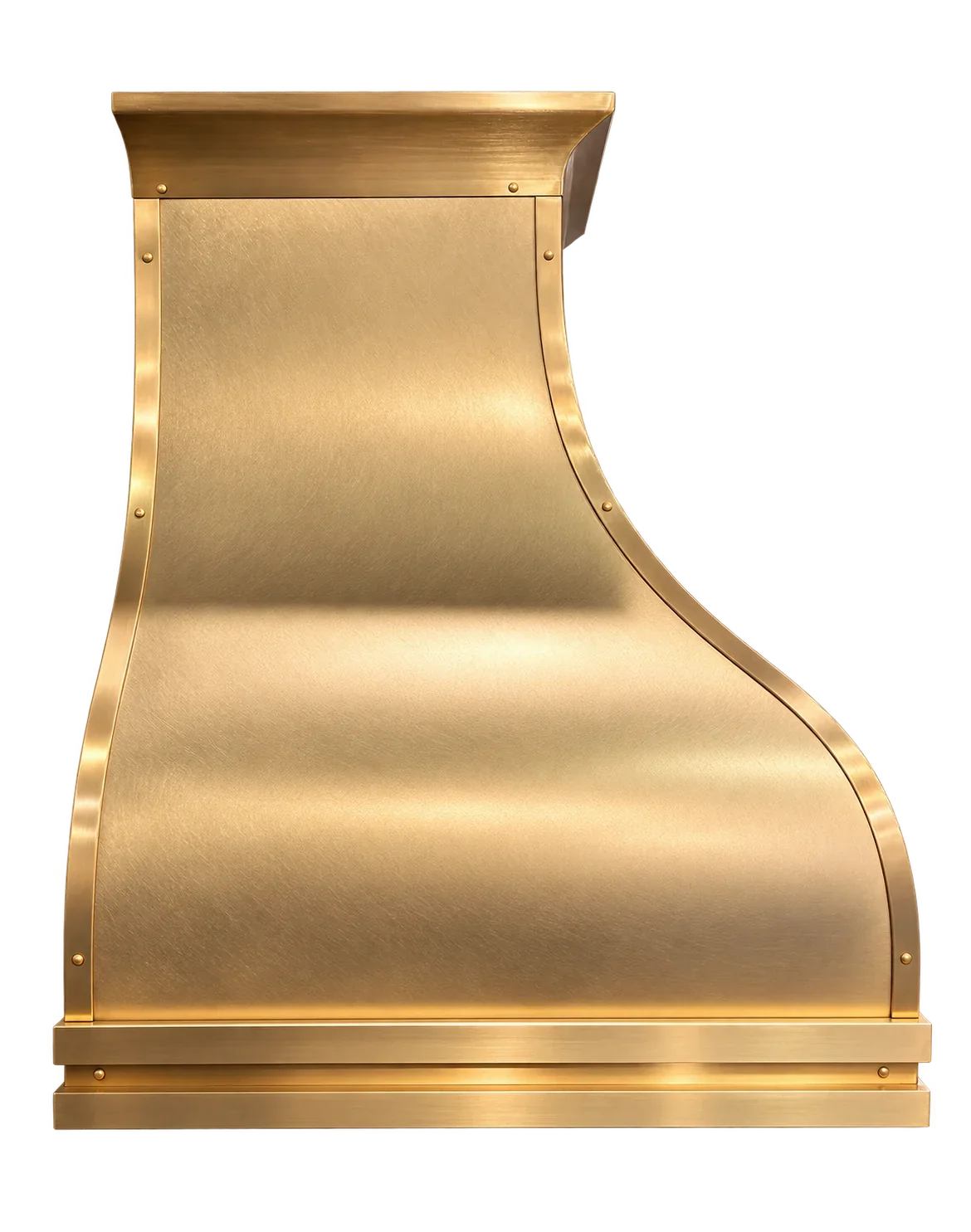
The Campo curve. The face bows outward in one sweep, as on the Campo hood at the top of this page.
The Havana curve. A crisp crown at the top, then a curve that flows into an understated apron. The Montauk was designed with a Havana curve silhouette.

Look at the side, not just the front
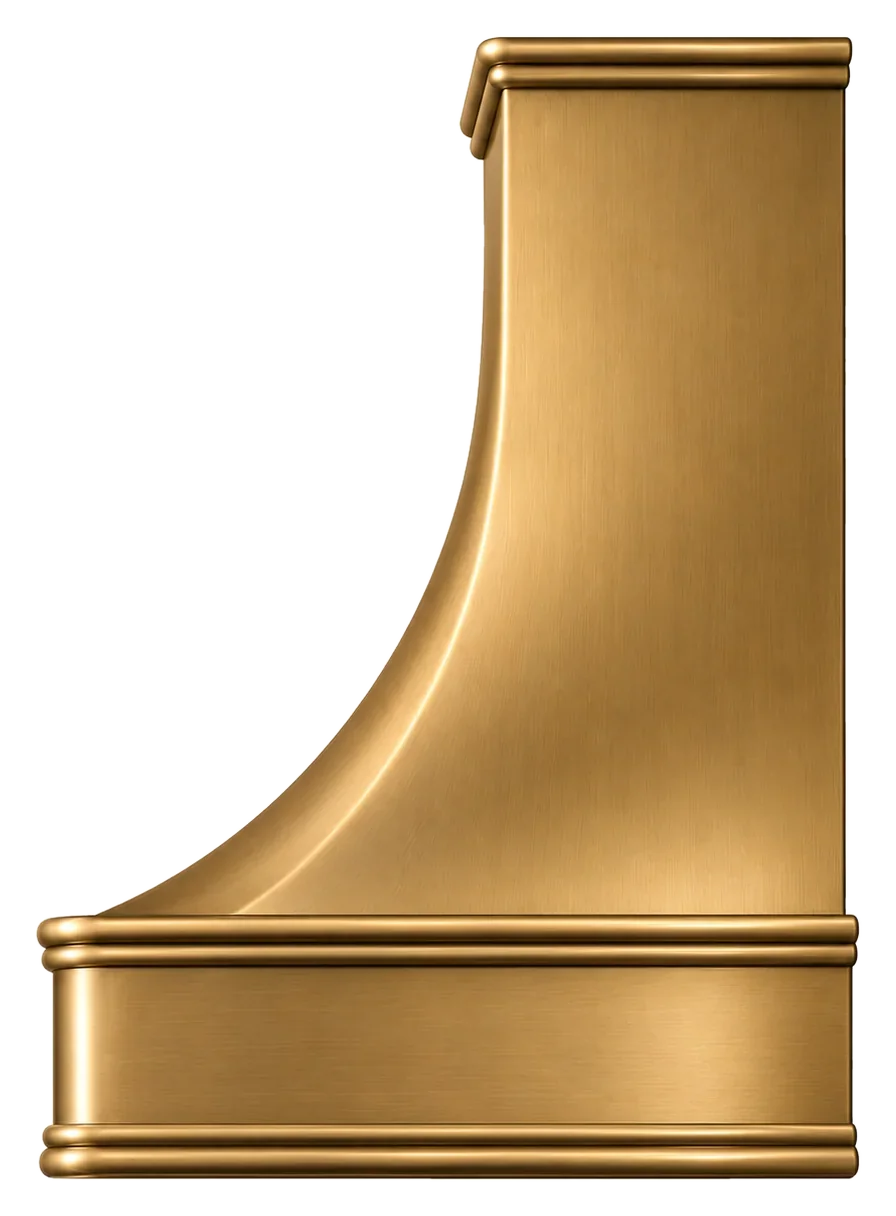
A front photo hides most of what makes a curved hood work. The side profile tells you how far the hood projects off the wall, where the curve starts, and how deep it sits over the front burners. Two hoods that look alike from the front can feel completely different from a stool at the island.
Match the curve to your ceiling
A curve needs vertical room to read. On a tall wall, a Monarch curve or a bell has space to sweep from crown to apron, and the shape carries. Squeeze the same hood under a low ceiling or a soffit and the curve flattens out, and the hood can look squat.
This is why the Long Island Collection is sized around common ceiling heights and stove widths. The Northport and Belle Terre were designed for lower ceilings and soffits. The Montauk offers models for wider ranges and for kitchens with soffits or cabinets over the hood. If your ceiling is tall and open, the Manhasset or a fully custom curved hood has the room it needs.
Bring your ceiling height to the first conversation. It narrows the shapes faster than anything else.
Straps that follow the curve
On a curved hood, the straps are where the hand work shows. Each strap is formed to follow the body, so a brass strap on a curve sweeps out with it and lands cleanly on the apron. Strap count, width and spacing change the character: fewer, wider straps feel bolder; more, narrower straps feel finer. The rivets sit on that line too. Domed rivets catch the light along the curve; flush flathead rivets keep it quiet. See all three fastener options on the finishes page.

Why curved hoods take more shop time
A straight box is cut and welded. A curve is formed, panel by panel, and every strap is shaped to match it. That is more fabrication time and more finishing time, because a brushed grain or an antique has to follow the form evenly. A curved custom hood falls within Monarch’s typical $5,500 to $20,000 and up range, with the shape’s complexity as one of the things that moves the number. The Long Island Collection takes the design work out of it: the curves, sizes and finishes are already set, and the designs start at $5,444.
Choose with the NY/NJ team
Kaitlin and Brendan work with homeowners, designers and builders across New York and New Jersey. They will look at your kitchen, your ceiling and your range, compare the curves with you, and arrange finish samples by local appointment or by mail. You do not need to know the model or the insert to start.
Curved range hood questions
What is the difference between a Monarch curve and a bell-shaped range hood?
A Monarch curve sweeps outward toward the bottom in one direction. A bell swells and then tucks back in, so the profile rounds like a bell. The Huntington is a Monarch curve; the Northport is a bell-shaped curve.
Will a curved hood work under a low ceiling?
Some will. The Northport and Belle Terre were designed for lower ceilings and soffits. The Huntington has an elongated curve that needs more vertical room to read.
Can I get a curved hood in a powder-coated color?
Yes. The Northport comes in white powder-coated steel with brass trim, and a fully custom curved hood can be built in powder-coated mild steel in a color matched to your cabinets.
Can I see a curved hood before I order?
Our NY/NJ team can arrange finish samples by local appointment or by mail, and every custom hood is approved as a CAD drawing before any metal is cut.